Tulane Special Collections Librarians Publish New Book on Curatorship
Published
By Becky Gipson
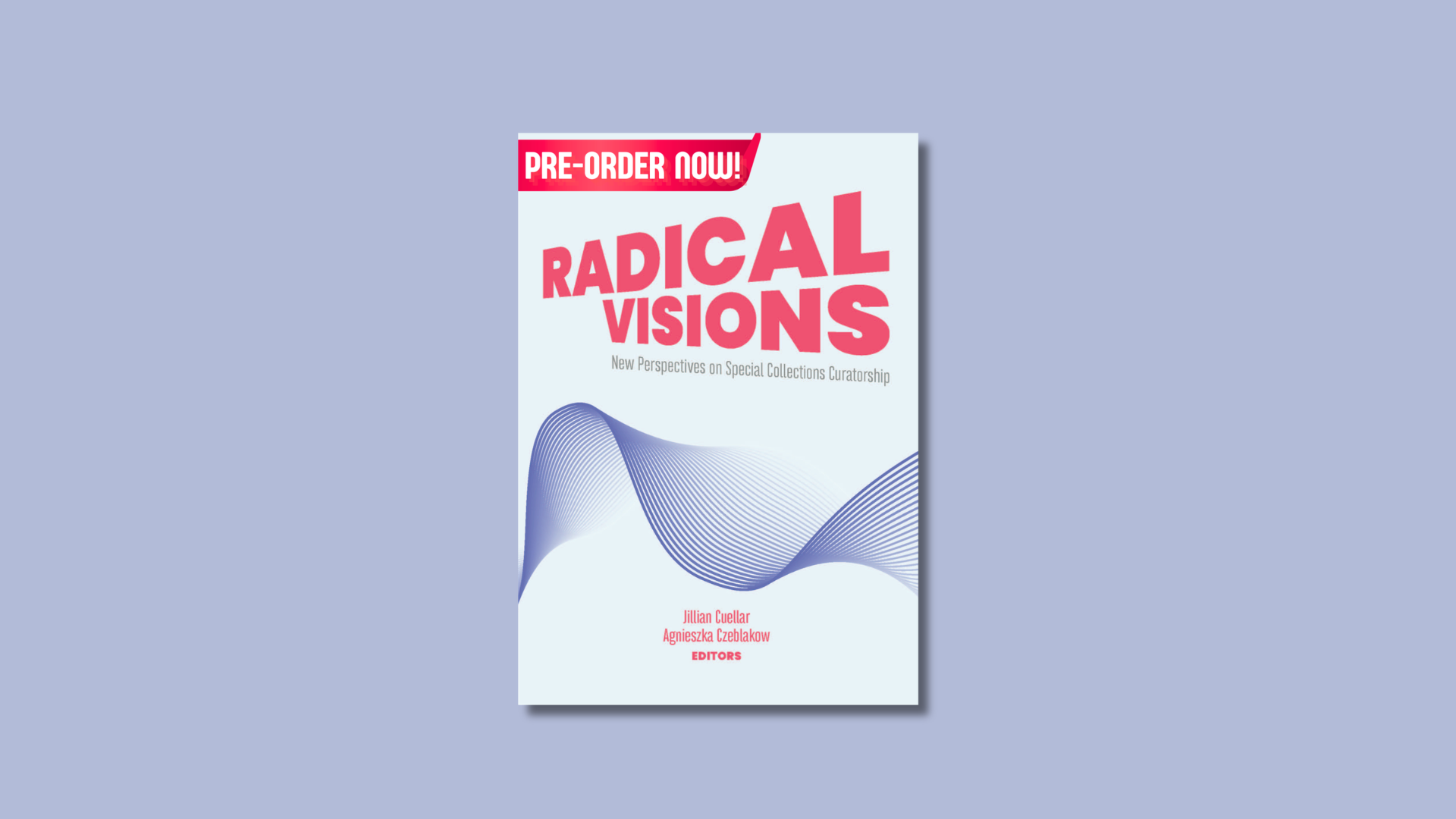
Tulane University Libraries is proud to celebrate the publication of Radical Visions: New Perspectives on Special Collections Curatorship, a new book edited by Jillian Cuellar, Director of Tulane University Special Collections, and Agnieszka Czeblakow, Head of Research Services & Curator of Rare Books. The volume is now available for order through the Society of American Archivists (SAA).
The book brings together an outstanding range of contributors to fill a long-standing gap in the professional literature on curatorial work. Cuellar and Czeblakow began this project through their own discussions regarding the need to better define the role of curator in the contemporary archives and special collections field.
"Curatorial practice in archives and special collections is severely understudied, despite the significant impact it has on the historical record,” Cuellar noted. An archivist by training, Cuellar turned to Czeblakow, whose background in rare books curatorship could help build a fuller picture that spanned both archives and special collections. "Agnieszka is an experienced curator," Cuellar said, "and I wanted to have her perspective and partnership."
A Book Built Through Partnership
Radical Visions grew out of an open call for proposals, supplemented by direct outreach to practitioners and scholars whose work Cuellar and Czeblakow felt offered essential perspective on the profession. The resulting collection is organized into four sections, Legacies, Intentions, Partners, and Possibilities, though the editors are quick to note these categories are intentionally porous, with many chapters speaking across the book's larger themes.
At the heart of the collection is a rethinking of what it means to be a curator today. Where the historical model of curatorship centered on acquiring and holding collections to build institutional prestige, the contributors to Radical Visions point toward a different model, one grounded in reciprocity, sustained relationship, and shared stewardship with the donors, creators, and communities whose materials make up special collections.
For Czeblakow, that shift is fundamentally about the posture a curator takes toward the collections and communities they serve. "To be a curator is to ultimately share and be a sharer," she explained, "rather than someone who collects materials for the institution and then becomes the sole authority over the collections, caring for them without inviting or encouraging broader participation, access, and engagement.”
A Resource for the Field
Contributors to the volume explore curatorial work through research articles, personal reflections, and practical guides, offering readers a way into a part of the profession that has often been defined more by informal mentorship than by shared literature. Chapters range from historical analyses of curatorial impact to firsthand accounts of how identity and lived experience can inform one’s work, reflecting the breadth of practice the editors hoped to capture.
The book's opening chapter comes from librarian and scholar Melissa A. Hubbard. Hubbard discusses the history of the special collections departments at Harvard and Yale universities, which represent the first two formal programs in the nation, examining how donor interests can influence and direct research and teaching for decades. Cuellar and Czeblakow note that this topic is foundational to the book's framing of curatorship's historical focus on building institutional prestige and its more recent turn toward stewardship and access.
Another standout contribution comes from JoyEllen Williams, Curator of the Rare Book Museum at Kennesaw State University. Williams's chapter recounts her work teaching rare book classes to incarcerated learners in a Georgia prison, an example the editors cited as a model of what it looks like to carry curatorial practice, and its materials, out of the reading room and into the community.
Hubbard's and Williams's chapters are joined by a wider roster of contributors whose backgrounds span archives, rare books, and community-facing collection work, reflecting the editors' intent to draw on voices from across the profession rather than a single institutional viewpoint.
Who This Book Is For
Cuellar and Czeblakow built Radical Visions with a wide readership in mind. Asked who she pictured reading the book, Cuellar's first answer was simple: "Anyone who wants to know what it means to be a curator." From there, the intended audience expands outward. The editors point to library and information science students as a core readership, noting that while researching the book's proposal, they found a shortage of coursework in library and archival graduate programs focused specifically on curatorial work. For students weighing a path into special collections, the book is meant to offer insights on a role that is often highly visible from the outside but rarely scrutinized.
The book is also written for working professionals already inside the field. Cuellar, who has spent more than two decades in libraries, described the role as something that is "often opaque, held in high esteem without questioning why,” even for those who work alongside curators daily. She sees archivists and librarians in that same position as a key audience: people who work near curatorial roles, wonder how those roles are filled, and want a clearer sense of what separates one curator's approach from another's.
Beyond individual practitioners, the editors hope the book reaches library school faculty, program administrators, and the directors and deans who ultimately decide how curatorial positions are defined, supported, and funded at their institutions, since, as the book argues throughout, viable curatorial work depends on administrative buy-in as much as it does on the curators themselves.
What This Means for the Current State of Curation
Radical Visions arrives at a moment when the profession is actively reconsidering who curatorial work is for and the methods for performing it. The book's contributors describe a field moving away from a model where success was measured by the size and rarity of what an institution acquired, and toward one where the measure is what an institution does with what it already holds, how materials get used in the classroom, activated for research, and shared with the communities they came from or represent.
For students and early-career professionals considering this path, the editors offer a few threads worth following. First, curatorial work rewards a long view: relationships with donors and communities can take years, sometimes decades, to develop, and the payoff is rarely immediate. Second, the role increasingly sits at the intersection of collection knowledge and relationship-building; the ability to build trust with the people and communities connected to a collection is as central to the job now as subject expertise. Third, the editors encourage students to think seriously about outreach not as an add-on to curatorial work but as one of its core functions, whether that means bringing materials into classrooms, community spaces, or, as Williams's chapter demonstrates, institutions well outside the traditional boundaries of a library or archives.
The editors are also candid that the book raises as many questions as it answers. Cuellar described Radical Visions as "a first step" in a longer process, one that starts with defining curatorial work clearly enough to build better training, support structures, and career pathways around it. For students entering the field, that means arriving at an unusually active moment: a profession still actively defining the shape of one of its most consequential roles, with real opportunity to help shape what comes next.
Looking back on the process of shepherding the collection from proposal to finished book, Cuellar described the editorial work itself as one of the project's greatest rewards. "We're both really proud of this book," she said, "and I'm especially grateful for the way that we got to engage so deeply with our contributors... it was just such a pleasure to get to work with people in that way, and it's been so exciting to share with all of them that this book is finally out."
Cuellar and Czeblakow hope the book will spark ongoing conversations about how curatorial roles are defined, developed, and supported across the profession. They emphasize that the publication is intended as a starting point rather than a final word, with additional projects already in development.
For more information:
Radical Visions: New Perspectives on Special Collections Curatorship is now available for purchase through the Society of American Archivists and Amazon.