"A Love Letter to Black Women": How One Tulane Graduate's Research Is Rewriting the Story of Who Gets to Be in History
Published
By Becky Gipson
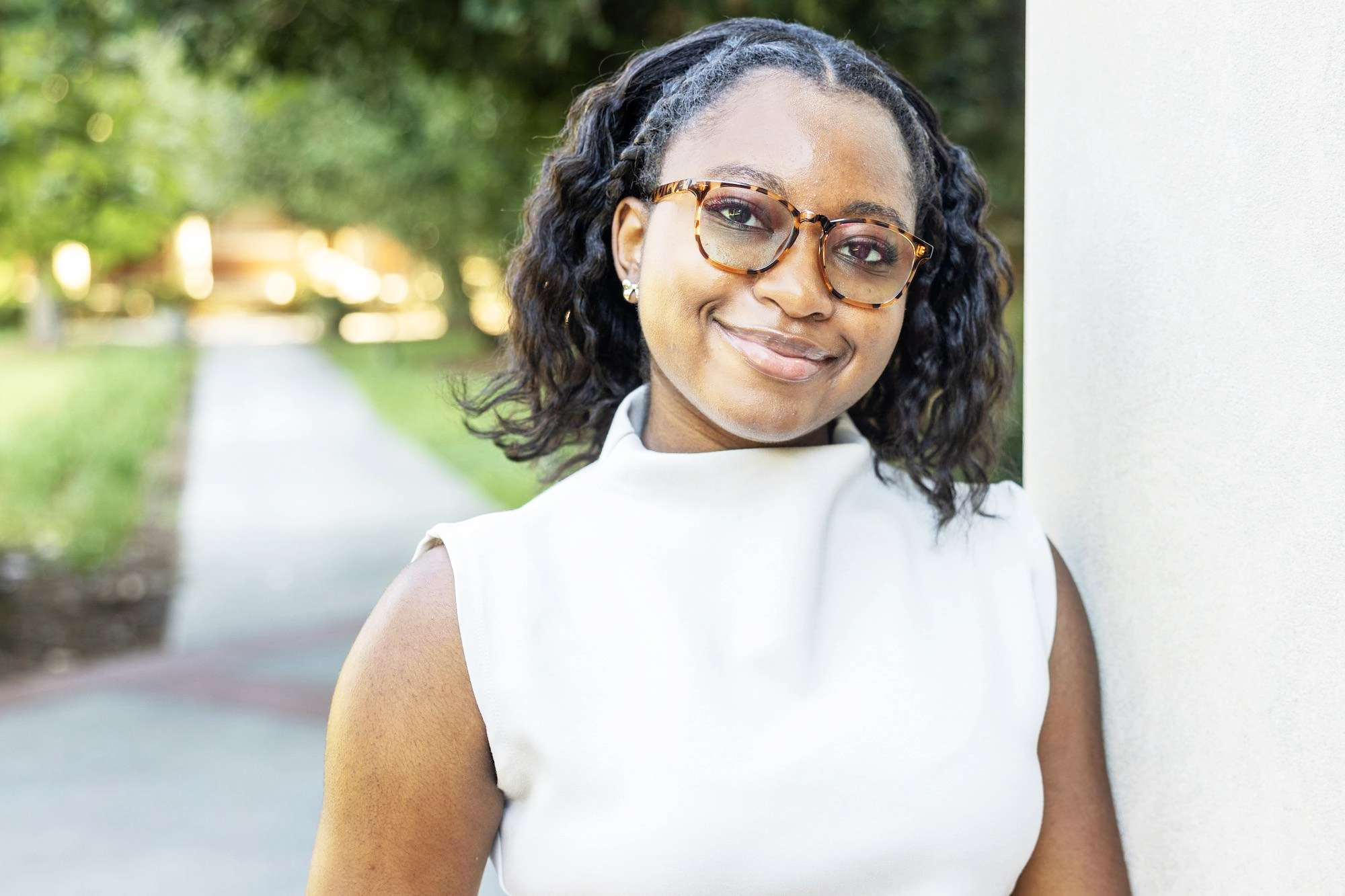
When Morgan Bennett set out to write her undergraduate thesis, she was warned, more than once, that her question was too big.
"I was told numerous times that my topic was 'too big for an undergraduate thesis,'" she recalls with a laugh. She kept going anyway.
The result is a meticulous, methodologically original study examining how Black women are represented — and systematically omitted — from a leading high school history textbook used in California, one of the country's most politically progressive states. This fall, she takes that work to Harvard Graduate School of Education, where she plans to turn her findings into policy.
Before she goes, her scholarship has found a second life inside Tulane's own library walls.
Starting with a Feeling, Building a Framework
Bennett's path to her thesis began not with a hypothesis but with a set of convictions: that history is a roadmap, not just a record; that students who see themselves in the curriculum are better positioned to imagine what they can become; and that the ongoing wave of book bans and curriculum censorship attacks something fundamental about the democratic promise of public education.
Her first instinct was to study the Common Core Curriculum and the political forces that shaped it. When she discovered that Common Core lacked a specific history standard, she pivoted, toward her favorite subject and a sharper question: who gets counted in the history we teach?
"I wanted to focus on representation as current book ban calls attack books and curriculum with diversity," she explains. "I wanted to see if students were seeing themselves in the curriculum, and history is one of the key places where students should, as it is the teaching about people and how we came to be."
The search for a textbook to analyze led her back to her own high school experience. She remembered that her 11th-grade textbook had come from California, a state whose progressive reputation made it a compelling case study. If an inclusive curriculum was thriving anywhere, it should be there.
What she found challenged that assumption.
What the Textbook Revealed
Morgan Bennett developed an original analytical framework to assess the textbook's content: she counted every person mentioned, coded how each mention appeared narratively, and measured the weight of each appearance by sentence count. The picture that emerged was striking.
Even in a 21st-century textbook from one of the country's most liberal states, exclusion was pervasive. Household names in Black activism were absent from the biography appendix. Brown v. Board of Education, arguably the most consequential Supreme Court case in American educational history, did not appear in the textbook's court case appendix at all.
"I and even my thesis committee were shocked by this," she says.
But Morgan Bennett was careful to ensure her thesis was not only a document of absence. Woven throughout the analysis is an affirmative historical account: the contributions of Black women to American civic life, the intersectional forces that have shaped how those contributions are framed and forgotten, and the structural reasons why exclusion persists even when good intentions are present.
“Morgan came to the project with a willingness to engage difficult questions about whose voices are centered and whose voices are marginalized,” said Melisa Balos, Social Sciences Librarian for the Scholarly Engagement department. “What was rewarding to see was how she interrogated those silences and challenged dominant narratives about Black women's role in American history. She was a joy to work with.”
"I had to make sure I was succinct but also gave Black women the recognition they deserved," she says. "This thesis served as a love letter — a love letter that thanked all of the Black female activists that came before me, as I would not be able to write this without their sacrifices."
The Library as Partner: Amplifying Voices
Bennett's connection to Tulane Libraries runs deeper than research access. She is also a key contributor to the Amplifying Voices display, a curated reading collection developed in collaboration with the Libraries' Scholarly Engagement Department to center the work of marginalized writers and scholars.
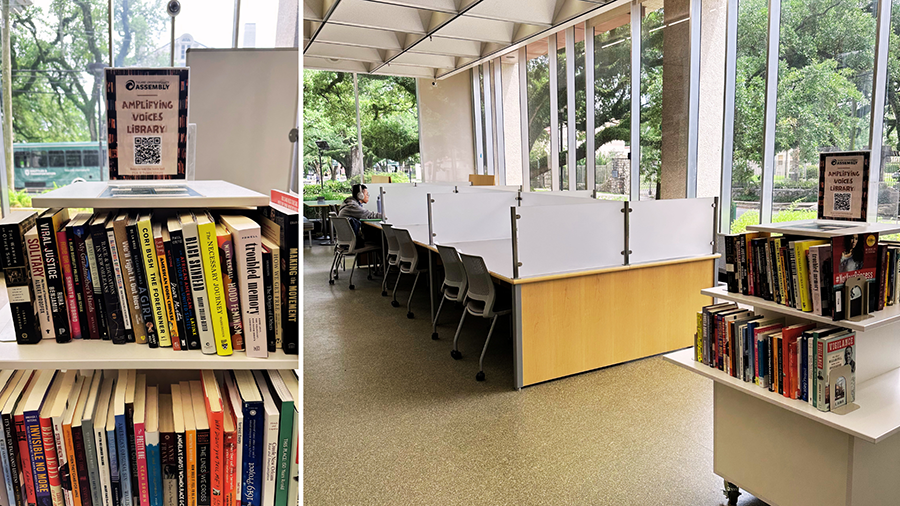
The project originated with 2023 Tulane Undergraduate Assembly co-chair Jay Heartly, who envisioned a resource that could make underrepresented voices accessible to the entire campus community. Morgan Bennett joined the effort early and has continued stewarding it since Heartly's graduation.
The collection spans reading levels and formats, chapter books, graphic novels, and longer academic and biographical texts, and was assembled with intentionality about both reach and depth. Popular titles like The Hate U Give appear alongside lesser-known works that might otherwise fade into the background. The goal, Morgan Bennett says, was never a checklist.
"I'm not entirely sure if we can say there was a criteria but more so a leaning into what felt right and what fit the needs of the Tulane community."
When asked which title she would press into every student's hands, she declines to choose just one, and the reasoning says something about her whole approach to education.
"I would recommend reading at least two of the books: one that you can identify with and one that you want to learn more about."
“The Amplifying Voices display is a testament to what happens when student colleagues and curators bring their energy, expertise, and ideas to the Libraries,” said Dean of Libraries and University Librarian, Lindsay Cronk. “Morgan Bennett’s vision and collaboration with our Scholarly Engagement team make this collection a vibrant resource that enriches our campus community. We welcome student curators to collaborate, and the results are consistently creative and inspirational.”
Going to Harvard, Coming Back to Classrooms
This fall, Morgan Bennett heads to Harvard Graduate School of Education with a clear agenda: to scale what she built at Tulane into a tool that schools and districts across the country can use to evaluate the inclusivity of their own textbooks.
"I plan to expound upon my study and create a framework, based on the one I created in my thesis, that will help schools and districts analyze the inclusivity and effectiveness of their textbooks," she says. "I hope this framework can be shared across schools and governance, especially during a time when inclusive curriculum is under attack."
Her vision of policy work, though, is not abstracted from the classroom. She speaks with equal urgency about being a visible role model — proof, in person, of what Black women can accomplish.
She dedicated her thesis to her younger cousins.
"They, like me, deserved to see reflections of themselves in what they are learning, and how they too will and can be successful, even when society doubts them."
A Question Worth Asking
For students who are sitting with a research question they are not sure is worth pursuing, Bennett offers the motto she carries everywhere: Be the change you want to see in the world.
"Challenge the systems in your research, ask the tough questions, and most importantly, lead with passion," she says. "It's ok if you have to pivot or start over, but as long as you are doing it out of passion, it will all work out. Trust, if you are passionate about it, then it is most definitely worth pursuing."
For more information:
The Amplifying Voices display is available for browsing in Tulane's Howard-Tilton Memorial Library in the first-floor lobby. Visit the Scholarly Engagement Department to learn more about research support, undergraduate thesis resources, and curated collections.