Home / Places / Rudolph Matas Library of the Health Sciences / Mission & History
Mission & History
The Rudolph Matas Library of the Health Sciences serves as the primary resource library for the Tulane University Health Sciences Center comprising the School of Medicine, the School of Public Health and Tropical Medicine, and the Tulane National Primate Research Center. The Matas Library supports the teaching, research, and patient care functions of the health sciences programs through the acquisition, organization and dissemination of biomedical information.
History of the Matas Library
The origin of the Matas Library dates from the founding of the Medical College of Louisiana (now Tulane University School of Medicine) in 1834. First mention of the library occurred in the faculty minutes of the College in 1844. In 1895, Dr. Rudolph Matas began his long history of support of the library, devoting much of his energy and fortune to the expansion of its collections and services, for the benefit of students and faculty at his alma mater and medical practitioners everywhere. The library was named in his honor in 1937.
Beyond the benefaction of Dr. Matas, other library endowments are those from the estates or families of Arthur Bernard Brown; Louis Augustus Burgess, M.D.; Herman Gessner, M.D.; C. Edmund Kells, D.D.S.; James D. Kenny; Isaac Ivan Lemann, M.D.; Andrew D. Mouledous, M.D.; Maurice Stern; Jacob Ambrose Storck, M.D.; Gloria Walsh; Eva Evelyn Weinstein; Harry B. Greenberg, M.D.; John L. & Elsie B. Martinez; and Guillermo Pacheco. Other funds that provide annual support to the Matas Library mission are the Alumni Medical Library Fund, Alumni Journal Support Fund, and History of Medicine Society Library Fund.
The Matas Library was significantly refurbished in 2008, including a redesign of the main reading room on the second floor of the medical school. The renovation allowed for 24/7 access to computing, printing, and scanning resources, including a new common, comfortable community study, and group study areas. The renovation and furniture purchases were financially supported by Dr. John Doty and the TUHSC Auxiliary. In 2021, the Matas Library received a generous gift from Clifford M. Gevirtz, MD and Alison M. Lazarus which provided for updated, modern study furniture throughout the library. In 2023, a project was undertaken in conjunction with the Tulane Libraries Annex Team to remove 32,650 serials volumes and 1,274 monograph volumes which had become redundant through purchases of historical backfiles. In early 2024, 42 ranges of shelving were removed from the Mezzanine Level, which opened a considerable amount of space to be repurposed as quiet, comfortable study areas with furniture relocated from the 2nd floor.
Four individuals served as the Library Director over the Twentieth Century: Jane Grey Rogers, Mary Louise Marshall, William D. Postell, and W.D. Postell, Jr. In early January 2009, the Matas Library came the leadership of a new Director, Neville Prendergast. Prior to coming to Tulane, Mr. Prendergast received a graduate degree in Library Science from the University of Buffalo and served as Assistant Librarian of the Health Sciences Libraries at Buffalo, then as Associate Director for Becker Medical Library at Washington University in St. Louis. In 2022, Keith Pickett was named Library Director after spending 12 years in various professional roles within the Matas Library. The Matas Library continues to be an essential resource for health sciences faculty, staff, and students in the Twenty-first Century, serving New Orleans' medical and public health communities in new and innovative ways.
Bronze Doors
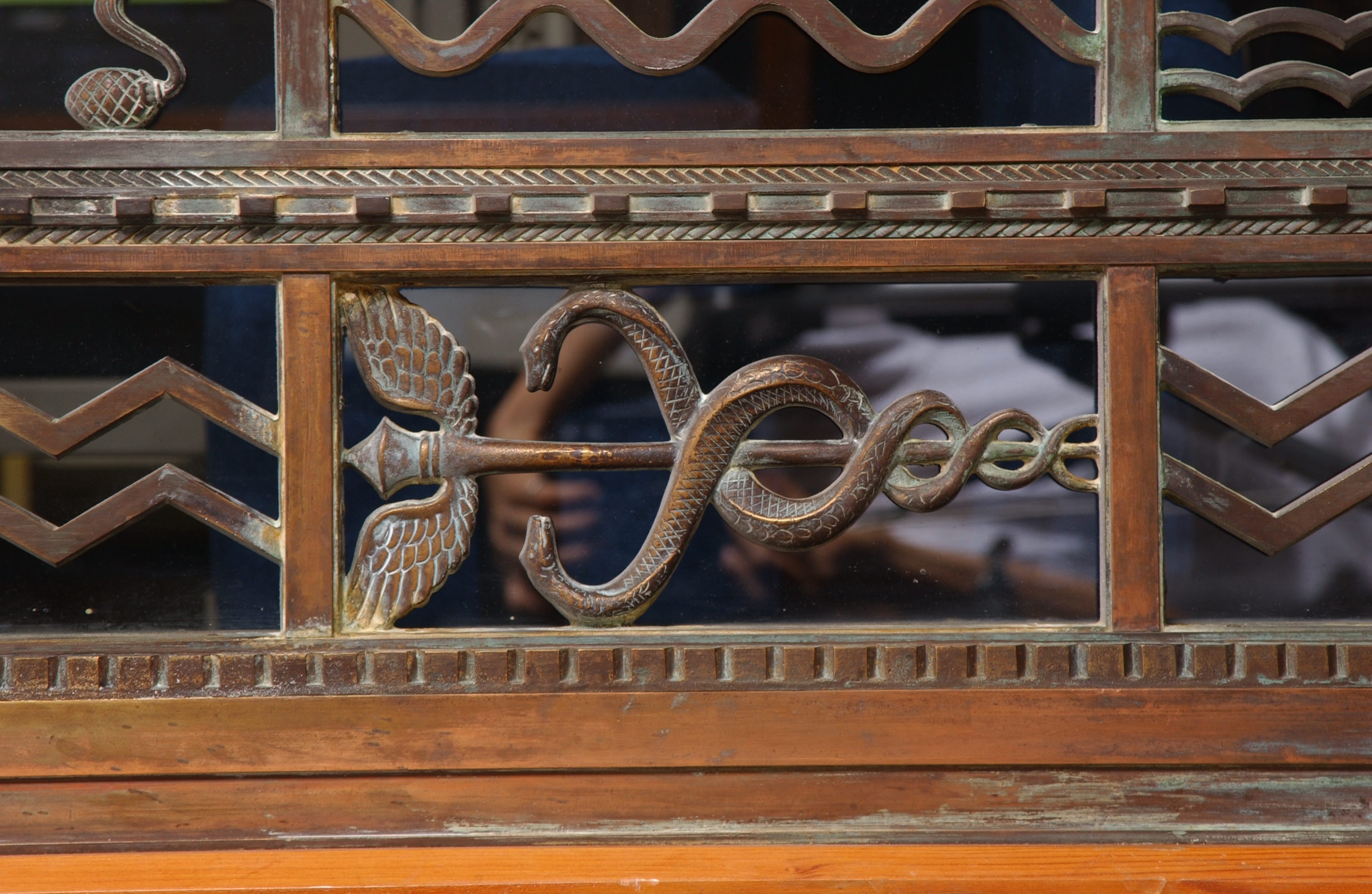
The bronze doors on permanent display in the Matas Library are the original doors from the old, main entrance to the medical school's Hutchinson Memorial Building on Tulane Avenue. The pair is extremely ornate, weighing more than 300 pounds each. They were designed in 1929 by Douglass Vincent Freret (1903-1973) of Favrot and Livaudais, Architects, for the main entrance to the Hutchinson Memorial Building on Tulane Avenue. The doors were installed in 1930 during the tenure of Dean C.C. Bass and dismantled in 1963 when the entrance was relocated to the new Burthe Cottam Building addition.
The doors were in storage for almost twenty years when they were resurrected and mounted in the Matas Library on either side of the old card catalog in honor and memory of Dean Bass in 1981. The card catalog is now a memory, but the doors remain as guardians of the printer and copier stations in the library.
There are many fine details and sculptures from the original building still adorning the building. The bronze tablet dedicated to the philanthropist, Alexander C. Hutchinson and his wife, Josephine, located on the LaSalle side above the Clinic entrance, was designed by Pietro Ghiloni. Angela Gregory (1903-1990) is the sculptor of the head of Aesculapius on the Hutchinson Memorial Building. The Hutchinson Memorial building of Tulane Medical School was inaugurated on December 10, 1930.
Founding of the Medical College of Louisiana
The Medical College of Louisiana, now Tulane University School of Medicine, was founded by three young physicians in 1834. They published a document, officially titled The First Circular or Prospectus of the Medical College of Louisiana. This is the original document pertaining to the establishment of Tulane University as a whole. This manuscript served as a copy for the printer announcement of and justification for the founding of the first medical school in New Orleans. It was drafted on 23 September 1834 by Dr. Thomas Hunt with the assistance of Dr's. John H. Harrison and Warren Stone. The Prospectus was published a week later, on 29 September 1834, in French and English versions on the front page of L'Abeille (The Bee), the local, bilingual newspaper.
The Prospectus caused a storm of controversy in New Orleans at the time. The French physicians of the community were outraged that these youthful American physicians of the community (the eldest of the three founders was twenty-six) should presume the latter were more qualified to teach medicine than the former. John Hoffman Harrison
With the formation of additional colleges, the Medial College of Louisiana evolved into the University of Louisiana in 1847. The University was renamed Tulane University, and became a wholly private institution in 1884.
Little is known about the subsequent history of The Prospectus manuscript: where it was kept, who cared for it or how it was handed down. The best guess is that it was preserved in the care of successive Deans of the School of Medicine or their assistants. In 1982 it was transferred from the Office of the Chancellor to the Archives of the Matas Library. The manuscript was first exhibited on 6 June 1987 at the Graduation Reception of the School of Medicine Class of 1987. Its condition is fragile and display is rare, limited to the most important School of Medicine and University anniversaries and ceremonies.
The pedestal and case for the preservation and display of The Prospectus manuscript was provided through the generosity of the School of Medicine Class of 1987 and the efforts of Gordon Patrick Marshall, M.D., Class President.
The Prospectus is not currently indexed in the Tulane online catalog, but the full text is available online and the document is part of University Archives. Contact the University Archivist for more information.
History of the Tulane University School of Public Health & Tropical Medicine
The Tulane School of Hygiene and Tropical Medicine began in 1912 with a donation from New Orleans businessman Samuel Zemurray. F. Creighton William served as the school’s first dean from 1913-1914, and was succeeded by William H. Seeman. In 1919, the School of Hygiene and Tropical Medicine merged with the College of Medicine. Degree programs for the Master of Public Health (MPH) and Master of Public Health and Tropical Medicine (MPH&TM) began in 1947, with doctoral programs beginning a few years later in 1950.
Grace A. Goldsmith became the dean of Tulane’s School of Public Health and Tropical Medicine when the school re-emerged as a separate academic unit in 1967. The first undergraduate class of public health students was admitted, earning BSPH degrees in 2008.
Historical information on the Tulane School of Public Health is available in the book: The Tulane University Medical Center: one hundred and fifty years of medical education, edited by John Duffy (LSU Press: 1984).
Tulane & Charity Hospital
The Charity Hospital Reports (1842-1966) were digitized via a National Library of Medicine award and are now available in the Tulane University Digital Library. 114 hospital reports are now online, open to the public and full-text searchable.
The Charity Hospital Reports (1842-1966) are digitized and open to all in the Tulane University Digital Library.
A restored video of the Demolition of Old Charity Hospital in 1937 was digitized by the Matas Library and is available in the Internet Archive.
Related publications:
- Flores, Adolph. A brief review of the administrative structure of Charity Hospital. Bulletin of the Tulane Medical Faculty, 18(3): 101-103.
- Grulee, Clifford G. Historical and current interrelationships between Tulane University Medical School and Charity Hospital. Bulletin of the Tulane Medical Faculty, 18(3):104-113.
- Katz, Alan. Big Charity: A History of Emergencies. Tulane Medicine, 23(1): 14-21. Spring 1992 (First appeared in New Orleans Magazine, Nov. 1991)
- Kostmayer HW. The Tulane School of Medicine: 1834 - 1960. The Bulletin of the Tulane University Medical Faculty. 1961; 20(4):219-239.
- Leighninger, Robert D., Jr. Big Charity: A History of New Orleans' Public Hospital. Louisiana Cultural Vistas (Fall 2007):p.19
- Ochsner J. The complex life of Rudolph Matas. J Vasc Surg 2001;34:387-92.
- Salvaggio J. New Orleans' Charity Hospital: A story of physicians, politics, and power. Baton Rouge: Louisiana State University Press; 1993.
- A Short History of the Ambulance Corps. Jambalaya, the Tulane University Yearbook, 1905. [pages 98-99]
Famous Tulanians
An A-Z List of distinguished Tulane Medical and Public Health Faculty and Tulane Health Sciences Alumni.