A Good Place to Stay for 33 Years: Andy Corrigan Retires, becoming Tulane Libraries’ Vice Dean Librarian Emeritus
Published
by Rebecca O'Malley Gipson
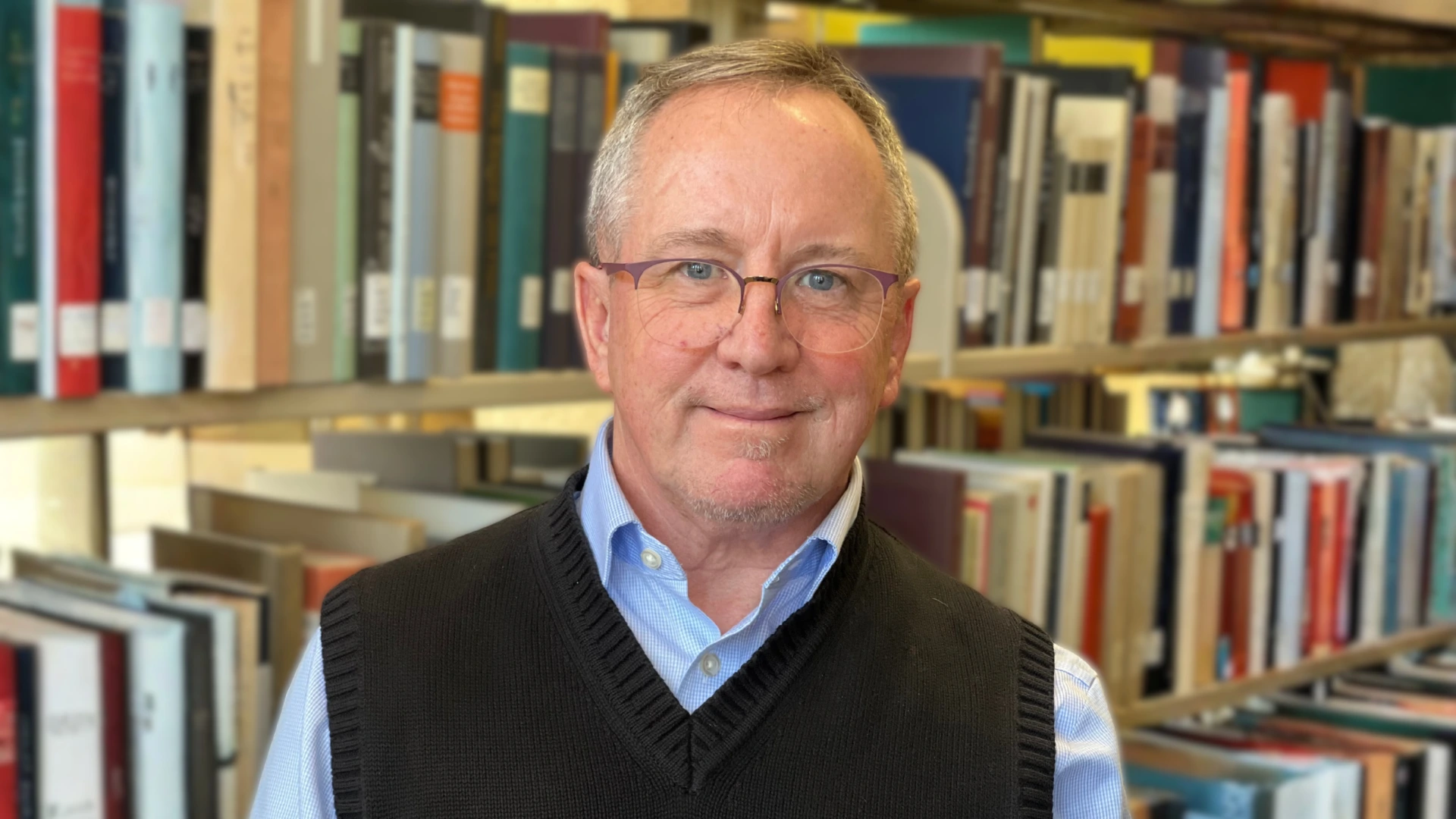
After 33 years of service to Tulane University Libraries — three decades that spanned a devastating hurricane, a multi-story building expansion, and a fundamental reimagining of what a research library can be — Andy Corrigan has retired. The Tulane Board of Administrators has recognized his contributions by naming him Vice Dean Librarian Emeritus. This title reflects both the scope of his service and the university's gratitude for it.
Corrigan came to library work by an unusual road. In the late 1970s, he was a young newspaper reporter in rural Vermont, chasing deadlines for The Caledonian-Record in St. Johnsbury during the Woodward-and-Bernstein era of journalism, pounding out stories on a typewriter and getting paid by the column inch. He later worked as a reporter and editor for bigger papers in Vermont and New Hampshire. It was, he says, "a grueling profession" — but one that taught him something he carried for the rest of his career: how to write, how to meet a deadline, and how to finish something completely, every single day.
That discipline served him well when he moved into library science, earning a doctorate in education administration from West Virginia University while also directing library services at West Virginia Graduate College, an innovative partner institution patterned after early Teacher Corps programs in Appalachia. In 1994, he arrived at Tulane to head a newly formed Information Services department. He would go on to hold nearly every senior leadership role in Tulane University Libraries over the next three decades: Head of Information Services, Assistant Dean for Collections and Information, Chief Collections Officer, Associate Dean of Libraries for nearly twenty years, Interim Dean from 2022 to 2023, and finally Vice Dean of Libraries beginning in 2024 — the chief advisor to the Dean and, in the Dean's absence, the Libraries' top administrator.
Rebuilding After Katrina
No chapter of Corrigan's career looms larger than Hurricane Katrina. When the storm hit in 2005, floodwater filled the basements of Howard-Tilton Memorial Library and Jones Hall, submerging books, government documents, microfilm, and irreplaceable archival materials. Corrigan returned to New Orleans before most of the university, working alongside the disaster-recovery firm BELFOR to determine what could be salvaged from the wreckage. Compact shelving had floated off its rails; mold set in fast. "That water was so nasty," he recalled, "you could just watch the mildew" take hold, once these spaces could finally be drained.
What followed was more than a decade of recovery work that Corrigan led as the Libraries' project manager: stabilizing damaged materials, navigating years of insurance litigation and FEMA claims, and eventually overseeing a $30 million, FEMA-assisted construction project that added a fifth and sixth floor to Howard-Tilton Memorial Library — replacing what the flood had destroyed. For eleven years, while that process unfolded, the library operated with a temporary HVAC system, installed along the back of the building, with suspended tubes bringing air through the windows to its public spaces, all while continuing to serve students and faculty without interruption. A separate Tulane Libraries Recovery Center handled the enormous task of processing more than a million restored and replacement volumes, helping the library itself to keep running.
Corrigan later reflected that the crisis, for all its hardship, brought people together around a shared purpose: rebuilding a great university and a great American city. His expertise in disaster recovery eventually made him a sought-after voice nationally and internationally, leading to presentations for UNESCO, the American Library Association, and the Association of College and Research Libraries, and to testimony as a principal witness in FEMA and insurance litigation on behalf of the university.
Building for the Future
Beyond the recovery effort, Corrigan's fingerprints are on much of the modern Howard-Tilton Memorial Library. He oversaw the transformation of the building's basement, once home to now-unusable collection space, into eight classrooms, offices, and study spaces, a project that turned a liability into one of the most heavily trafficked corners of campus. He led large-scale collection relocation initiatives that moved hundreds of thousands of volumes to free up space for students, and he worked closely with university architects on renovations throughout the building, from graduate study spaces to a new 53-seat library classroom.
He counts among his proudest achievements a pay equity initiative he developed with new Dean of Libraries Lindsay Cronk and Associate Dean of Operations Maria Pham that delivered raises of 10 to 15 percent to underpaid library staff — a problem, he said, that had long felt intractable until they found a way to solve it.
"Books Are Important, So Is an Open Mind"
In a farewell message to colleagues, Corrigan reflected on how fortunate he has felt to have joined the library profession nearly forty years ago. He said he hoped that "forty years from now, people will still, or once again, believe that: books are important, and so is an open mind." He pushed back on the notion that younger generations have lost interest in reading and argued that libraries' core responsibility is to cast a wide net, offering people the widest possible range of material and trusting them to cast a wide net in their research as well.
Asked what advice he'd offer to those carrying the work forward, Corrigan didn't reach for a grand pronouncement. Legacies, he said, are overrated; what matters is listening closely to what library users say they actually need, rather than assuming what they should want.

Corrigan plans to ease into retirement slowly, alongside his wife, Trish Del Nero, who has also recently retired, from teaching kindergarten at the Willow School. They will begin with plans to spend more time with their three children, now young adults, and this will require some travel. What he says he'll miss most isn't any building or project, but the people: colleagues across the university he has worked alongside for decades, and the daily rhythm of a job he clearly loved.
Reflecting on his 33 years at Tulane, Corrigan sums it up simply: it was, he says, "a good place to stay." The wider Tulane community joins the Libraries in thanking him for his decades of leadership and in wishing him a well-earned and relaxing retirement.