Spain, Spanish America, and the Atlantic World in an Age of Revolution
Published
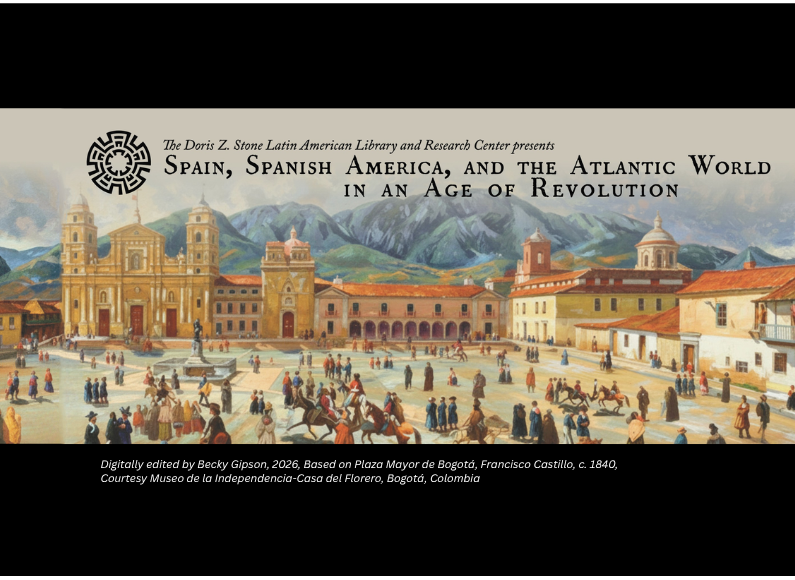
Between the 1760s and the 1820s, the Atlantic world became a theater of political upheaval. People, information, and commerce crossed oceans in service of empires, linking Spain and Spanish America to wars and revolutions on both sides of the Atlantic. Drawing on the exceptional holdings of the Doris Z. Stone Latin American Library and Research Center at Tulane University, this exhibition brings that era to life through rare books, newspapers, manuscripts, broadsides, maps, and early constitutions. With particular emphasis on Mexico, Central America, and northern South America—areas of longstanding strength within the collection—it presents independence as a prolonged often bloody process of political experimentation and conflict, not a single event or the result of any one cause.
The exhibition opens with competing empires and contested frontiers. Rare maps and official correspondence on display reveal Spain’s efforts to strengthen its authority through the Bourbon reforms. Spanish Louisiana occupies a prominent place in this story. From New Orleans, Spain supplied the United States with arms and financial assistance during its war for independence. After Spain entered the conflict against Great Britain in 1779, Louisiana governor Bernardo de Gálvez led campaigns along the lower Mississippi and Gulf Coast, culminating in the capture of Pensacola in 1781. Rare documents from the Tulane collections illuminate Louisiana’s role in a contest that redrew the political geography of North America.
The age of revolution was also an age of inquiry. Enlightenment thinkers measured, classified, and described American lands and peoples, sometimes in the service of imperial control and sometimes to assert the cultural authority of American-born intellectuals. Rare gazettes and scientific journals from several colonial cities show how knowledge entered a new public sphere and helped shape political debate.
The exhibition also examines the crisis that shattered the Spanish monarchy. Napoleon Bonaparte’s invasion of Spain in 1808 and the forced abdications of King Charles IV and his son Ferdinand VII raised an unprecedented question: in the absence of the legitimate king, where did sovereignty reside? Rare contemporary sources capture the confusion of those first months and trace the emergence of responses ranging from loyalty to the deposed monarch to constitutional reform and, eventually, independence. Central to these debates was the Constitution of Cádiz of 1812. Drafted by representatives from Spain and Spanish America, it established a new framework based on national sovereignty, representation, and citizenship. Its promise was brief: Ferdinand VII abolished the constitution and restored absolute monarchy in 1814. Speeches by Spanish American delegates to the Cortes of Cádiz and the royal decree announcing the constitution’s repeal offer compelling glimpses into these critical debates and their abrupt reversal.
Throughout the exhibition, particular attention is given to the circulation of information across the vast distances of a far-flung empire. Colonial printing presses carried a constant flow of news, decrees, political arguments, and rumors. Revolutionary and royalist newspapers and pamphlets cast insurgents as either liberators or dangerous rebels. Rare documents from 1815 also reveal New Orleans, by then part of the United States, as a center of revolutionary activity and political intelligence.
Regional cases devoted to Mexico, Central America, and northern South America reflect longstanding strengths of the Doris Z. Stone Latin American Library’s collections. The section on Mexico includes unique militia and provisions lists bearing Miguel Hidalgo’s signature, as well as the declaration issued by the Congress of Anáhuac (1813), and the Constitution of Apatzingán (1814). Together, they evoke a revolution fought not only on battlefields but also through acts of political creation.
In northern South America, rare documents chart an extraordinary—and deeply contested—effort to build new political communities amid revolution and war. The processes of independence in the region were not simply a break with Spain; from the outset, it involved a struggle over what kind of government should replace imperial rule. That debate continued after military victory, and proclamations and political writings reveal Simón Bolívar, the hero of independence, as a contested figure in debates over executive power and constitutional government.
Central America’s experience unfolded differently. Rather than emerging from the prolonged warfare seen elsewhere, its 1821 declaration of independence resulted from a negotiated transfer of power led by criollo elites. The declaration and contemporary newspaper accounts capture both the aspirations of the moment and the continuity of political authority beneath the formal break with Spain.
The exhibition concludes with constitutions of new republics. As birth certificates of nations, they transformed declarations of independence into structures of government, defining institutions, rights, and the boundaries of citizenship.
The documents on view in this exhibition preserve the immediacy of an unsettled age. They remind us that the revolutionary Atlantic was shaped not only by leaders and battles, but also by printers, mapmakers, couriers, spies, lawyers, legislators, readers, and ordinary people confronting an uncertain political future.
For more information:
The exhibition Spain, Spanish America, and the Atlantic World in an Age of Revolution will be on view September 24th through May 2027 at the Doris Z. Stone Latin American Library and Research Center located on the fourth floor of Howard-Tilton Memorial Library, 7001 Freret Street, New Orleans, LA 70118.