Where the Forest Speaks: How One Student Brought Ecuador's Rainforest to Tulane
Published
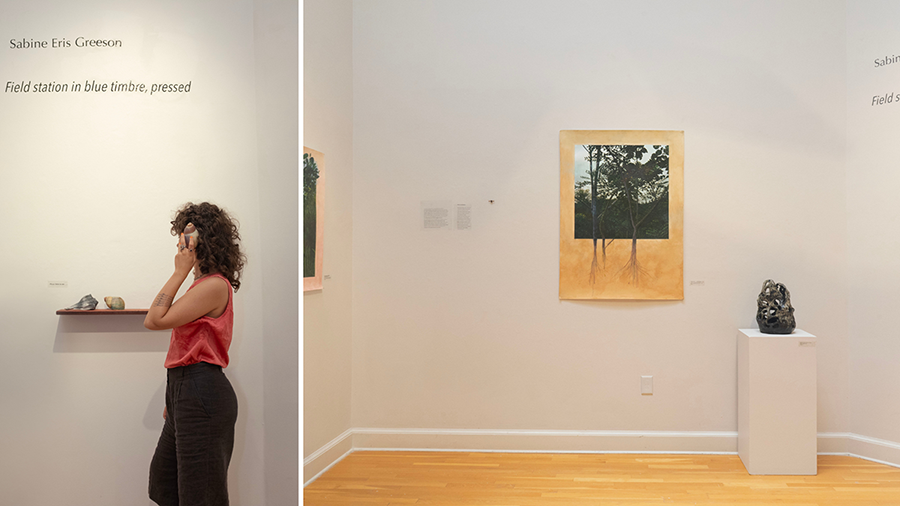
Image caption: Field Station in blue timbre, pressed, exhibit photo by Sabine Greeson
By Becky Gipson
The Ecuadorian rainforest doesn't just exist. It sings. Bright calls, rustling canopies, and sounds found nowhere else on Earth create a symphony that senior Sabine Eris Greeson spent two summers learning to hear. That symphony was brought to Carroll Gallery.
Greeson, completing dual degrees in Interdisciplinary Art (B.F.A.) and Environmental Biology (B.S.), recently presented their senior exhibition, a layered, luminous installation of cyanotypes made from plants collected deep in Ecuador's Chocó Biogeographic Zone. Behind that work lies not only months of fieldwork, but a quieter story: that the recordings at the heart of it all were made possible by Tulane University Libraries.
From Field Station to Gallery Wall
Through the Tulane Interdisciplinary Environmental Research and Action (TIERA) program and the Continued Scholars program at Fundación para la Conservación de los Andes Tropicales (FCAT), an Ecuadorian rainforest conservation NGO, Greeson returned for a second consecutive summer to FCAT's biological field station in Ecuador's Esmeraldas province, situated within one of the world's most critically threatened ecosystems. There, over the course of the season, they collected over 12 hours of field recordings and interviews, shot four rolls of film, and created 17 cyanotypes on tissue paper featuring 34 native plant species.
They also led a cyanotype workshop with the local Women's Art Collective, bringing a photographic technique with deep roots in scientific documentation to a community living at the intersection of conservation and economic pressure.
The library's recording equipment made the soundscape component possible. Greeson checked out professional audio gear through Tulane Libraries, using it to document what scientific observation alone can rarely capture: the acoustic ecology of a place. Buff-throated saltators, Chocó toucans, howler monkeys, Imbabura tree frogs, and the ambient thrum of crickets and katydids are among the voices preserved in the recordings, a living catalog of biodiversity that may, without conservation intervention, one day fall silent.
"Intentional Listening" and the Acoustic Ecology of the Chocó

Earlier this spring, Greeson shared those recordings publicly as part of Intentional Listening, Tulane Libraries' annual series inviting audiences to experience sound with curiosity and intention. Their presentation explored not just what the rainforest sounds like, but what those sounds mean, and what their disappearance would signal.
Acoustic ecology, as a field, holds that sound is data. The density and diversity of calls in a healthy ecosystem reflects the health of that ecosystem. When species vanish, their voices go first. Greeson's recordings offer both a document and a warning.
The Exhibition: Light, Tissue, and Bloodwood
The Carroll Gallery installation takes all of that fieldwork and transforms it into something you have to stand inside to understand.
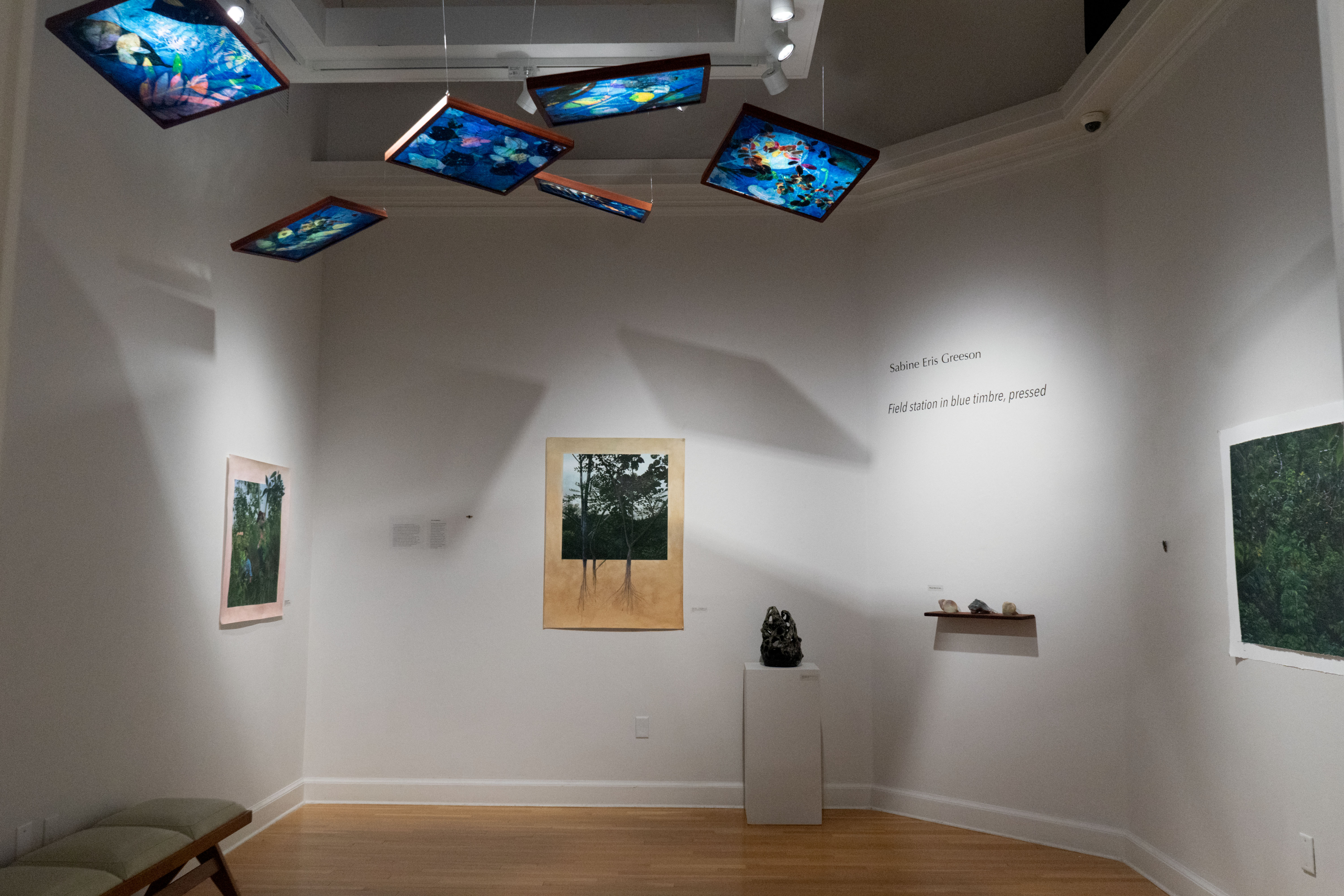
Cyanotypes made from 34 native Chocó plant specimens are printed on tissue paper, a deliberately fragile choice, requiring careful technique to prevent tearing during washing. That delicacy is the point. The process left the finished prints with wrinkles and pooled texture, which contrast with the crisp white silhouettes of the plants themselves. Layered and hung from above, the translucent sheets create shifting negative spaces where organic lines collide. Lit from behind, the blue deepens and glows, evoking, Greeson writes, "the serenity and quiet mystery of the forest canopy at night."
The frame is bloodwood. The choice is not incidental. Bloodwood trees, when cut, run red. In framing cyanotypes of a disappearing ecosystem within a product of its deforestation, Greeson collapses the distance between documentation and consequence.

Cyanotype printing has a long history as a tool for botanical documentation, a way of pressing a plant's exact form into light-sensitive chemistry, creating a record in scale. Greeson works within that tradition while complicating it. The layering of prints asks visitors to question what they are seeing: Is this species still there? Is this only a shadow? Many endemic species in the Chocó remain undiscovered; others are known only by their absence. The work holds both possibilities at once.
The installation also speaks directly to the economic pressures driving deforestation in the region. Non-native cocoa cultivation has accelerated forest clearing, perpetuated by inequitable global economic structures with roots in colonialism. The forest acts as a carbon sink; when trees fall, that carbon is released. Greeson makes the stakes explicit: when you cut the tree, we will all also bleed.*
Checking Out More Than Books
Tulane University Libraries offers students access to a range of equipment beyond the stacks, including the professional recording gear that Sabine Greeson used to document an entire ecosystem, which included a Zoom H6 Handy Recorder. Whether you're working on a documentary, a sound installation, a research project, or something that doesn't have a name yet, the Libraries can help you make it.
Visit this link to learn more about equipment lending and other resources available to Tulane students.
*Greeson, S. (2026). Description of Forest Fragments in Bloodwood [tissue paper, cyanotype, acrylic, watercolor, mineral oil, and bloodwood]. Carroll Gallery, New Orleans, Louisiana.