"A Chunk of Life": Tulane's Dean of Libraries on the Power and Promise of Libraries Reaffirmed
Published
by Lindsay Cronk
I've been trying to describe this past month to colleagues back at Tulane, and I keep landing on the same phrase a fellow delegate, Llarina González Solar, used the day we all flew home: "What a week this has been. I don't even know where to begin. Perhaps by admitting that it wasn't really a week at all. Just a chunk of life."
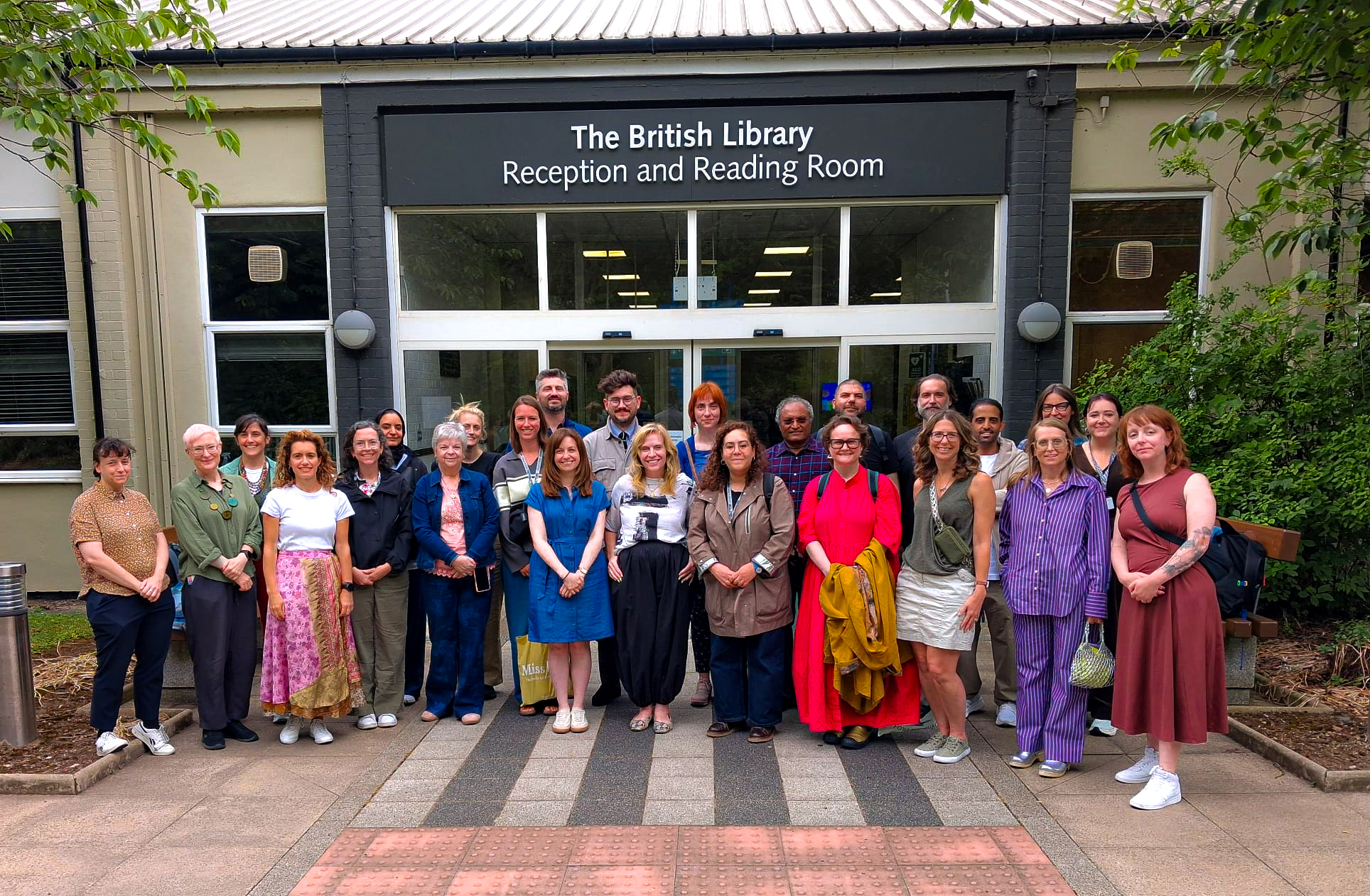
Now in its seventh year, the British Library's International Library Leaders Programme (ILLP) brings together mid- to senior-level library and archive professionals from around the world for a week of behind-the-scenes access most visitors never get — storage facilities, the conservation studio, working sessions with experts at both St Pancras and Boston Spa, the Library's off-site storage and distribution facility in York. The cohort is kept small on purpose, and I understand why now. A tighter group is what turns a week of programming into something closer to a lasting network. This year there were 22 of us, from Israel, the UAE, Colombia, Uruguay, Spain, Amsterdam, Australia, Bosnia, Ireland, India, and beyond.
I'd applied specifically hoping to see Boston Spa, and it turned out to be the moment that stayed with me longest. The site runs several generations of high-density storage technology side by side — a net-zero building is under construction, but the earlier generations haven't been discarded; they're still in use, refined by what the Library learned building them. There is no waste in their improvements. It gave me a lot of hope about how you continue to use what you have even as you learn from what was less than optimal. What struck me most wasn't frustration with the status quo, but a deep appreciation for existing resources — a lesson I've already started carrying back to how we operate at Tulane, in the Gulf South, through our own period of climate and political transition.
Midway through the week, I was asked to give remarks on behalf of the full cohort, following presentations from Sophie Lancaster of Arts Council England and Dame Carol Black, Chair of the British Library Board. Preparing them brought me back to something personal: why I became a librarian in the first place. I believe that human knowledge is our greatest shared inheritance, and that libraries are the infrastructure that ensures it is accessible and safeguarded. Talking with fellow delegates across a dozen countries that week, I found the same conviction running through nearly everyone in the room — the sense of being part of one long, shared chapter of stewardship.
That's the part of ILLP I think will outlast the week itself. My fellow delegate Llarina González Solar, library coordinator at the Council of the European Union, called our cohort "fellow time travelers" in her own reflection afterward, and closed by quoting something I'd said back to me — about the confidence the week gave me in the future of our profession's stewardship.
Over the six prior years, ILLP has brought together delegates from 40 countries, and I've heard enough alumni stories now to know those relationships don't stay contained to the week. A delegate from the University of the West Indies helped the Library establish an Endangered Archives Programme Hub for the Caribbean. A 2022 alumna's connections led to a memorandum of understanding with the National Library of South Africa. Two alumni from different cohorts and different South American countries met through the program and are now co-designing impact indicators for libraries together. Someone put it to me this way: ILLP is proof that leadership pipelines can also be friendship pipelines.
If you'd asked me on the tour whether there was a moment I thought, we need to try this at Tulane — honestly, so many times. Multispectral imaging was one. Seeing the technology behind the Library's recovery of the Cotton Genesis, one of the earliest surviving illuminated Bibles, badly damaged in an 18th-century fire, sent me home thinking harder about what our own imaging and automation work — already underway through an ITHAKA AI cohort and a Google Books partnership — might become.
The other was the British Library's approach to public-facing exhibitions, a stronger emphasis on immersive storytelling and drawing the public directly in. We're already moving in that direction at Tulane, particularly with exhibitions in the Doris Stone Latin American Library and Research Center and the "we have that" pop-ups by Tulane University Special Collections, but the visit sharpened my sense of what more gallery and exhibition space and infrastructure could make possible.
If a fellow university library dean asked me whether the week away from campus was worth it, I'd tell them this: it is desperately important that leaders be learners — that we have the capacity and humility to know that we should be growing and improving if we expect our libraries to stay as vital and relevant as they need to be. This programme was such a gift, both in terms of that learning and in terms of building relationships with library leaders across the globe.
The 2027 cohort runs Wednesday 28 July to Wednesday 4 August, timed deliberately just before London hosts the IFLA World Library and Information Congress, so delegates can take part in both, and alumni from every past year have a reason to come back together. Applications open this autumn at link.bl.uk/ILLP. If you're a library leader on the fence about applying — go.